Monday, June 29, 2009

Change in Sea Ice

Ice CapA bigger image can be seen at Paul Krugman's blog post, but check out the reduction in the polar ice cap on just thirty years. What's interesting to me is that there is almost no change at all on the eastern side, the North Sea, and along the northern coast of Greenland; but the western side, in the Bering Sea, the change is pretty dramatic. Is the Pacific Ocean warming more than the Atlantic? Or is something else at work?

Update: Wednesday 1:30pm
Oops, the Gulf Stream has been doing that for centuries. I am an idiot.

Computer problems will mean very little posting until I get it fixed.

Update: Wednesday 7:00pm
It was not a virus, technically "malware," so apparently all of those porn sites I've been visiting did not burn me after all. It was something that either M$ Vista or Google was doing to me. If you ever have computer problems the folks at Virtual Dr. are awesome.

Update: Thursday 9:00am
Well, no, Virtual Dr. declaring me malware free or not, the problem is still extant. The issue seems to be, in medical parlance, "idiopathic," meaning "we don't have a clue what's causing it." It's certainly beginning to make
me "idiosomething" all right.

"Supporting the Troops"

Back when a Republican was president and kept funding his wars with “special” bills in Congress, the Republicans would target Democrats who voted against those bills as “unpatriotic” and as “voting against the troops.”

The persons voting against those bills often were not voting against the war funding at all, but against some pork that the Republican majority had tacked onto those bills, but that didn’t stop the Republicans from their “voting against the troops” attack ads. Often there would be two versions of the same bill and a Democrat would vote for the one without the pork and against the one with it; that Democrat would still be cited for voting against the second bill and attacked for “voting against the troops.”

The practice was widely decried by the Democrats as ridiculous, dirty, and “unfair,” and I fully agreed with all of those descriptors. The campaign ads and sound bites rather seriously annoyed me.

Now that we have a Democratic president funding his wars with “special” bills in Congress, we get this from Think Progress last Friday,

Now, the Democratic Congressional Campaign Committee (DCCC) plans to run ads on the July 4 holiday criticizing several vulnerable Republican members for their votes against the supplemental last week. As Glenn Thrush reports, “A series of 60-second radio ads will run during drive time from July 1 through July 8, according to a script provided to POLITICO — and they have the support-our-troops ring of GOP spots.”

Do I think this is acceptable now that Democrats are doing it rather than Republicans? No, I do not. It was deceptive at best when Republicans did it, and it is deceptive now when Democrats are doing it. I do not like politicians deliberately distorting facts in order to mislead people into supporting their politics, no matter who those politicians are.

The end does not justify the means.

Sunday, June 28, 2009

"Leadership" for Gay Issues

Suppose that, in the 1960's, President Johnson had signed a bill giving blacks the right to ride in the front of buses that were on even numbered routes. "Civil Rights is a tricky issue right now," he would say, "and I'm dealing with this war in Veet Nayum. I'll get around to the Civil Rights thing later, but for now here's a little bit to make you happy. You can ride in the front of even-numbered buses."

That is pretty much what Mr. Obama has done for gay rights so far, and as Frank Rich points out in an NY Times op-ed yesterday, it is a long way short of what he promised in his campaign. Frank Rich is not happy with Obama's "leadership" on gay issues, with his recognition of public opinion, or with his willingness to keep promises made to those who supported him in his bid for the presidency. Like Mr. Rich, I am unhappy with Obama's failure to lead on this issue, and like him I do not see the need for it.

Unlike Mr. Rich I am beginning to suspect a reason, and it is not pretty.

Saturday, June 27, 2009

Strange Affair

I don't usually comment on the various political wick-dipping episodes, but this Sanford guy has me seriously baffled. His wife discovered the affair back in January and while they are "working on their marriage" he keeps "asking her for permission to visit Argentina?" Really?

There are quite a few debatable reasons for him to resign; abandoning his office, moral turpitude, frolicking at taxpayer expense, being generally pathetic... But asking your wife for permission to visit your mistress?

The man is a loon. Ipso loquitor. "The thing speaks for itself."

Friday, June 26, 2009

Elder Statesman

Jimmy CarterI did not vote for Jimmy Carter either time, and I do not say that with any pride at all. Quite the reverse. This man is turning out to be one of the greatest statesmen this nation has ever produced.

The only Middle East nation with which Israel is at peace is Egypt, a peace forged by Jimmy Carter, and one that has lasted for thirty years and has survived the subsequent assassination of the leaders of both nations. He began his presidency with a pursuit of peace in the Middle east, and he has never stopped.
A Haaretz Editorial last year said that, “For the peace agreement with Egypt, he deserves the respect reserved for royalty for the rest of his life.”

The man is in his eighties, for heaven’s sake, and he is still at it with the energy and stamina that many much younger men could not maintain.
The release of an Israeli soldier held by the Palestinians, in exchange for Palestinians held by the Israelis, appears close to becoming a deal and Carter’s hand is quietly and unobtrusively part of the process. Glenn Greenwald explains in some detail how diplomacy, by Carter and the Obama Administration, has been at work in the process and a picture emerges of a tireless elder statesman quietly pursuing a peace agenda.

The idea to transfer Shalit to Egypt in exchange for the release of Palestinian women, teens, cabinet ministers and parliamentarians being held in Israeli prisons was raised about a year ago during a visit by former U.S. president Jimmy Carter to Damascus, Jerusalem and Gaza... Carter raised it again on his visit earlier this month...

Emphasis added by me. I wish we had more like him.

Thursday, June 25, 2009

Misplaced Priorities

Farrah Fawcett, a beautiful and gracious person who fought a battle with cancer for 30 months with grace and courage, lost that battle today with barely a whisper in the press. I suspect there are many in the country right now who do not even know that she is gone. She fought her fight with only the degree of publicity needed to inspire others who are faced with similar difficult paths. Self pity or personal gain were never part of "Farrah's Story."

The press is too absorbed with the death of a rock star who lived his entire life as a monument to self adulation and lived his last years as a pedophile and a monster. Hour after hour of archival footage of this grotesque excuse for a human being is played as politicians and stars rush to microphones to praise his contributions to rock music, conveniently ignoring his lifelong grossly self-indulgent lifestyle and the wrecked lives of children left in the wake of his twisted passions.

Men and women are dying in Iran in the quest for freedom. Our soldiers are placing their lives on the line in Iraq and Afghanistan in defense of this nation. Great and weighty matters of long-term import to the entire nation are being debated in Washington. There is a crisis of energy and global climate change. And the media is absorbed in the death of a has-been, pedophile rock star.

Something is wrong with the priorities here.

Weaponized Keynesianism

I sometimes halfway wish, when I see Barney Frank speak, that I were not both married and straight. I swear, I would move to Washington and make a run at him. I know, he has a partner, but still... He comes up with some of the most penetrating and delightful statements. Like this one, quoted by Paul Krugman, about people defending a Cold War weapons program,

These arguments will come from the very people who denied that the economic recovery plan created any jobs. We have a very odd economic philosophy in Washington: It’s called weaponized Keynesianism. It is the view that the government does not create jobs when it funds the building of bridges or important research or retrains workers, but when it builds airplanes that are never going to be used in combat, that is of course economic salvation.

Given the comment, I perhaps should add that I'm thinking intellectually here, not... Oh, crap, maybe I should delete the post.

Healthcare and Vaporware

I watched the ABC News “Prescription for American Health Care” yesterday and was reminded of a term we used in the computer software business; “vaporware” was software that was promised or advertised but which never actually existed.

The President was far more oblique, slippery and just plain dishonest in selling his “health care reform” than he ever was on the campaign trail. In the latter case he was selling a really good product, himself, but now he is trying to sell vaporware. He is trying to sell a package that consists of nothing more than tinkering with and expanding the existing system as if it was “fundamental reform.” In the process he is having to dodge questions, claim that things will happen that won’t happen, and just plain lie.

He used the Mayo Clinic to illustrate cost containment, for God’s sake. Now, the Mayo found my health problems when other medical systems could not four years or so ago, and I am grateful to them for that. They are an incredibly fine medical center and I admire not only their medical service but the manner in which they provide it. Every procedure they billed me for, however, was tagged by my insurance for me to pay about 40% of the billed amount as being “above reasonable and customary,” so I have trouble seeing them as a model for cost containment.

The President of the AMA asked him how he could assure that a person’s treatment was going to be dictated by the person's doctor and not by some government bureaucracy, and the President went into his five-minute speech about “If you like the plan you have you will be able to keep it...” Obama not only wasn't in the ballpark of answering the question, he didn’t even enter the city in which the ballpark is located.

Asked about the $1 trillion+ cost, he referred to “up front costs” and talked about offsetting it with savings that “may be realized” from various things. When a former Medicare Director asked what he could offer “that the CBO would count” he put on his short skirt, picked up his pom poms and went into a cheerleading routine about how "America always meets challenges."

Indeed we do, but getting a grip on vapor transcends mere “challenge.”

Usual Vapid Reporting

There are ongoing wars in Iraq, Afghanistan and Pakistan. There is a Swine Flu Pandemic. Obama and Congress are tangling on several very important pieces of legislation. There is a crisis in Iran. So of course Chris Matthews spent his entire hour dissecting the amorous misadventures of a Republican Governor, and Olbermann spent more than half of his hour doing the same.

Wednesday, June 24, 2009

Action Required

Immediately upon inauguration, Barack Obama announced that the use of torture was banned, to thunderous applause. Everyone breathed a sigh of relief; a dark day in our nation’s history was over, a chapter closed.

Well, not so fast. A small band of Bush loyalists began prating about Obama’s actions making the nation less safe, and glorifying the use of torture as somehow having prevented a host of undescribed disasters following September eleventh. The media, instead of ignoring them, saw a delicious conflict which they could feed on and have been running with it ever since.

Obama is saying only that “we prefer to look forward” and the torturers are glorifying and defending their actions. The result is not pretty. A Washington Post/ABC News poll released Tuesday contained the following question,

"Obama has said that under his administration the United States will not use torture as part of the U.S. campaign against terrorism, no matter what the circumstance. Do you support this position not to use torture, or do you think there are cases in which the United States should consider torture against terrorism suspects?"

Support for not using torture has dropped from 58% in January to only 50% now. For "cases to consider" the response has risen from 40% to 46%.

Put another way, in January we are against the use of torture by 58%-40%. We still are, but in June the margin is down to 50%-46%, which is getting pretty marginal. Of course, I thought the January margin was rather sickening, but my point is that the numbers are going the wrong direction. A full half of this country is unwilling to take a stand against the use of torture.

It also asked,
"Do you approve or disapprove of Obama's decision to close the U.S. military prison in Guantanamo Bay, Cuba, early next year?"

In January 46% approved, and 45% still do. The disturbing part of the response is that in January 39% disapproved and now a full 50% do. More people want to keep Guantanamo Bay open than want to see it closed.

What happened to all of the thunderous applause that followed the announcement about banning torture? What happened to electing a president based in part upon his promise to close Guantanamo?

If anything ever illustrated the need to investigate and prosecute the misdeeds of the past, it is this. It is that all of this ineffectual condemnation of these misdeeds without action, all of this talking and allowing “point-counterpoint” discussion, all of this permission of endless self-justification by the perpetrators of the misdeeds; all of this “normalizes” those misdeeds. Those polls tell us exactly why we need to appoint a special investigator and bring to justice those who ordered torture, and those who performed it. We need to release photos, and we need to hold trials.

With all of this actionless prating about it, we are slowly moving toward becoming a nation of torture. Guantanamo Bay is becoming a symbol of who we are.

Slightly warmer, but...

June GloomAnd sun in some afternoons. Whee.

Italy's Got Talent

My friend in North Carolina sent me this one. I really like the kid in the nerdy glasses, but all of them can sing, and I'm not all that hot for opera. As for the announcer, red is definitely her color and I could never speak Italian; my lips and tongue would just never move that fast.

Tuesday, June 23, 2009

Public Option, Trojan Horse

The “healthcare reform” debate is now condensing down to whether or not there will be a “public option” included in it. Dr. David Himmelstein raised an interesting point in an interview with Bill Moyers back in May, suggesting that such an option might not only be irrelevant but might actually be to our disadvantage. But first, to restate my case that what is being discussed is not reform at all. Here is President Obama, with a phrase that he has repeated many times,

We have historically a tradition of employer based health care and although there are a lot of people who are not satisfied with their health care, the truth is that the vast majority of people currently get their health care from their employers, and you've got this system that's already in place.

The emphasis, added by me, is just plain a false statement. Ford Motor Company does not employ a horde of doctors and nurses and own a network of hospitals. People do not get healthcare from their employers. What they get is health insurance from their employers, and if they are “happy with what they have and don’t want to lose it” it is because they have never had to use it due to any kind of serious illness.

I am covered by my wife’s employer-provided plan, one of the “gold plated” plans that Obama wants to tax. To obtain the best degree of coverage, the plan limits me to certain doctors and hospitals, it restricts what medications it will pay for, and when I got sick in 2003 my out-of-pocket expenses came to more than $30,000 for the year. Happily, we were not in a position that a financial impact like that bankrupted us. Others are not as fortunate.

Bill Moyers: You had had cancer of the uterus, and while your husband was suffering from heart disease. And you went bankrupt even though you were insured?

Donna Smith: Yep. That's why I was asked to testify. I tell people that our story, my husband's and my story's not unique. It's not because we're so unique that people talk about us because we're not unique. So many millions of Americans do what all middle-class families do. You hang on. You watch your premiums rise over time and your benefits shrink. And as long as you're healthy, you absorb some of that cost and you deal with it and you make decisions.

But if you get sick, you find out just how inadequate that insurance may be. And I tell people not only did I have health insurance, I had Aflac disability insurance and a health care savings account on top of that. So we were like the prime example of responsible people who try and keep ourselves covered. And yet when we got sick, there was no way the deductibles and out-of-pocket maximum exposure added up so quickly that we were buried very quickly financially.

So how, precisely, does extending health insurance to more people solve that part of the problem? How does having health insurance help someone who cannot pay the $500 deductible? If someone cannot afford that first $500 of medical expense then they have no access to healthcare, whether they have insurance coverage or not.

The Public Option
The public option is touted as a method of keeping the private insurance “honest” by competing with them while not having to make a profit, thereby driving down the cost of insurance. The unvoiced hope is that it would eventually drive the private plans out of business and lead to single payer. Enter Dr. Himmelstein, single payer advocate, who says that the public option is a half measure that provides only small savings at best.

Bill Moyers: There aren't any details. But he seems to be advocating a public option that would compete with the private insurance-driven sector, as a way of lowering the cost. What do you think about it? Is that- am I reading his plan correctly?

Dr. David Himmelstein: Well, most of the cost savings he's talking about are really illusory, I think. And my research group has done most of the research work on administrative costs in health care. And the administrative costs he's talking about saving are a tiny fraction of the potential savings under single-payer. 'Cause hospitals have to keep their bureaucracy, if you're dealing with hundreds of different plans. And doctors have to keep the bureaucracy in our office. You don't actually get the streamlining that you get from having one payer that has one set of rules and can pay lump sum budgets to hospitals. But more than that, we're worried that the public plan actually becomes a dumping ground for the unprofitable patients. As it's happening in Medicare.

You can go read the transcript of the interview, or watch it, but to condense the argument a bit, it consists of three parts; you are eliminating the bureaucracy of a handful of insurance companies but not that of thousands of medical providers, the private plans will “cherry pick” the healthy people and dump the sick ones into the public plan, and instead of leading to single payer the public plan winds up failing and proving that “government can’t do healthcare.”

The first point is certainly right; you have not reduced the cost for one single doctor’s office. That doctor still has to deal with all the differing forms for different insurance companies, plus the new public option, and deals with obtaining payment from all the multiple sources. This “healthcare reform” has made no cost savings here.

I question that there is any administrative cost savings at the insurance level. No one has indicated how the addition of a public plan will cause the insurance companies to reduce staff, other than a desire to reduce costs. One way to reduce costs is to reduce benefit payments, and that seems like a significantly likely outcome. Maybe they’ll trim their “overhead” but that is, as the doctor points out, pretty trivial compared to the provider overhead that cannot be trimmed.

The second point is an illegality, but since when has that ever stopped corporate America? Dr. Himmelstein points out that, despite bring illegal, it is routinely being done with Medicare today, and you can bet it will be done with a public option.

The third point, not really made well in the interview since the idea of a public option as a bridge to single payer is being kept below the horizon lest it scare supporters away from it, is that with all the sickest people being dumped on it and therefore operating with severe losses, the public option can then actually be used as proof that government-run healthcare is not viable, leading to the return of private health insurance dominance.

My question is, why do we have to go there in baby steps and half measures at all? The obvious answer is, of course, that we have no leadership on the issue but that begs the question. Why do we have no leadership for single payer?

Barack Obama says that going to single payer is “too disruptive.” What? Are we children who cannot handle disruption? As Dr. Himmelstein points out, it doesn’t disrupt the doctors or hospitals, they just continue to practice medicine, but their billing and collections get a lot easier. Agreed, the insurance executives will find it fairly disruptive.

Canada took the plunge in the early seventies. They just said, “Okay, let’s do it.” And they did it. Are we less courageous, less able, than Canadians?

Dr. Sidney Wolfe: ... [a]nd in Canada, back in 1970 or so, they were spending the same percentage of their gross national product as we were on health. They had huge numbers of uninsured people. They had the same insurance companies. Blue Cross Blue Shield. They decided to just get rid of the health insurance industry.

And the guy that led that, Tommy Douglas, founder of Canada’s national healthcare system, was voted by Canadians who use that system as the greatest leader in Canada's history.

Not half measures; not health insurance; healthcare. Just do it.

Not-Boring Volcano

My nephew tipped me off to this view of Sarychev Peak blowing its stack; he knows I like volcanos. It was taken from the International Space Station on June 12th and, as far as I'm concerned, the ISS just paid for itself with this one picture. Click on it for a bigger image, and NASA has a page about the event here.

Monday, June 22, 2009

"Green Shoots" Facade

I was wondering how the number of new unemployed increased last month, and by quite a lot, but the "jobless" number actually declined a bit. I had a feeling it was not a reflection of people getting jobs, and suspected it was people running out of time-limited unemployment benefits.

I was right. Once you run out of benefits, you are no longer unemployed.

Perspicacity in Reportage

During the NASCAR race yesterday a reporter came up to the crew chief of the driver who was leading the race and asked, "How does your driver plan to handle this restart? What is his plan?"

I so wanted that crew chief to reply, "Well, it's a tough decision, but we're thinking he might press the freaking gas pedal real hard."

Some reporters can't help it; they are just morons.

Independent Justice

Obama has been under fire recently for supporting several decisions by the Supreme Court which flew in the face of campaign promises; one decision which shut down a civil suit based on "state secrets," another that offended same-sex marriage supporters, and most recently one in which the court ruled that convicted persons did not have the right to DNA testing for the purpose of appeal. (To over-simplify all three issues.) In all three cases "Obama’s Justice Department" actively sought and argued for the ruling that the Supreme Court made.

It seems to me that Obama critics are being a bit hypocritical here, but I’m not sure to what degree that is the case. From where I sit it looks like the same people who were screaming about Bush interfering with the Department of Justice are now screaming about Obama not doing so.

Let’s go back to a "major scandal" about the firing of a handful of Attorneys General by the Bush Administration and the subsequent resignation of Alberto Gonzalez. Wasn’t one of the biggest criticisms of Fredo that he let the president interfere in the operation of the Justice Department?

The Department of Justice is supposed to administer justice impartially, apolitically. The uproar over Gonzalez was that it failed to do that.

In all three of the cases mentioned above, Obama is being criticized for refusing to reverse arguments that had begun during Bush's administration, or to at least cease making those arguments, but doing that would have been blatantly political, would it not? Is it okay for the president to order the DoJ to change its position in the middle of an ongoing court case? My understanding of the nature of an "independent, apolitical" Department of Justice is that it is not.

When Bush put his hand into the operation of the DoJ we criticized him for doing so, and now that Obama is not putting his hand in we criticize him for not doing so. You can’t have it both ways saying, in effect, "We want the president to keep hands off when we don’t like his policies, but now that we have a president with policies we like we want him to interfere."

We’re critical of him for not violating principle? I’m not sure of this because I have no legal training and I’m not certain of precisely how independent the Department of Justice is supposed to be, but it’s food for thought.

Sunday, June 21, 2009

CA, NV, AZ, NM...

yeccchThe entire western part of the country is cloud-free. The lower left corner, as usual, basks in the dank grayness of the "marine layer." The only variation from "patchy fog" in our forecast is "chance of drizzle." June sucks.

Our hottest day on record occurred in October; don't recall the year.

Economic Nonsense

For the most part, I avoid opining on the financial crisis at any detailed level because I don’t really know enough about it. I do know enough about it that I get tired of Congress critters repeatedly saying that we have to accept whatever Treasury proposes because the whole subject is too complicated for anyone other than Timothy Geithner to understand it. My response to that little piece of sophistry is that if a Congressman doesn’t understand the bill in question, then he should recuse himself from voting on it.

I also know enough to reject the fond idea, embraced even by Barack Obama, that the economy will recover and all will be well if we can just get banks to resume lending and persuade consumers to start buying again. Once those two things happen, all of the unemployed will, apparently, in some magical fashion become employed.

Oh wait, I forgot the 150,000 jobs that have already been “created or saved” to replace the six million lost jobs and the ongoing 400,000 jobs being lost every month. I also forgot the untold jobs that will be created by the high-speed rail projects in the Stimulus Bill; projects which will be built at some yet-to-be-determined place in a yet-to-be-determined year.

Banks, having learned something of a lesson, are not going to lend money to people who are unemployed or underemployed; nor are they going to make loans secured by products and real property that is declining in value.

Which leaves getting consumers spending, and the only engine for that is by “restoring consumer confidence in the economy.” That project is actually going rather well, and consumer spending is increasing by fractions of a percent every month, which is enough to bring the stock market roaring back to levels almost equal to thirty years ago.

Paul Krugman is, of course, still saying that the government needs to directly stimulate the economy with spending that directly creates immediate jobs. The public, believing the dulcet tones of its president however, has gained so much confidence in the economy that it is willing to ignore the still-increasing job losses, and is now much more concerned with the federal budget deficit, ala’ 1935.

At least in 1935 they waited until unemployment was no longer rising, had dropped from 25% to 15% before they started prating about eliminating the simulative spending and balancing the budget.

Today, unemployment is a “a lagging indicator” that will magically reverse itself once we get banks to resume lending and persuade consumers to start buying again.

Saturday, June 20, 2009

Photo Food Blogging

Barbeque Basket Grill, starting with a picture of the finished product.
The Finished ProductWe're going to try some photo-blogging; not giving a recipe, but providing pictures of the process of making one of our favorite one-dish meals. This is a mixture of meats and vegetables, all grilled together on the barbeque. The dish is flexible, as one can throw in whatever ingredients one has on hand or strike the fancy of the moment.
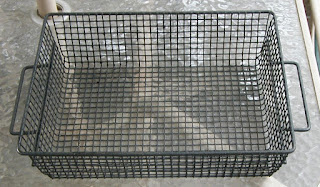
The BasketYou start with a basket like this one. I don't know where you get these; we got this at Bed, Bath and Beyond quite a few years ago, and they don't carry it any more. There are some so-called "baskets" that are sheet metal with holes punched in them, but I don't think they would work well; I think you want to look for one made of wire mesh. This one is 11" by 14" in size, but size isn't critical. You do want one that is pretty deep, though.

Start your grill to preheat, if you are using charcoal or a gas grill with lava rock. You want a pretty hot fire.

The VeggiesNext you want to chop some veggies into smallish pieces. As you can tell, we like mushrooms. Note to self, next time don't cut the Zucchini in half lengthwise before slicing it. That's a bit of a sore point, my wife hates Zucchini and has to sort of "eat around it" when I put it in. Use sweet onions, Vidalia or whatever your store has that is equivalent; the onions are not going to get all that thoroughly cooked and anything other than sweet onions will be a fail.

You can use whatever vegetables you want, but you should not use any vegetable that is at all fragile. You will be stirring this mixture in the basket and anything which is not very sturdy will just come apart and make a mess. Tomato and eggplant, for instance, are definitely out.

Toss VeggiesPut the cut-up vegetables in a bowl, add a generous amount of olive oil and then sprinkle with whatever herbs you like. I use Oregano, garlic power and just a bit of Thyme. Toss that well in the bowl and let it sit for a minute to allow any excess oil to drain off.

Spray the basket well with cooking spray (please don't do this anywhere near the grill) put the basket on the grill and dump the vegetables into it, being careful not to pour any drained olive oil (which will flare up) in with them. There may be some initial flare-up anyway, so have a squirt bottle handy to quench it.

I know we haven't mentioned any meat yet; the vegetables take longer to cook than the meat does. I realize that sounds counterintuitive but, trust me, I've done this before.
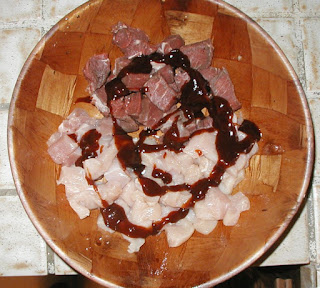
Prepare MeatWe'll let the vegetables be cooking while we cut up the meat in smallish pieces. We're going to be a little busy, because we need to periodically stir the vegetables; about every couple of minutes or so.

For meat, I usually use a mix of beef and chicken; you could use either one alone if you like. You could also add some shrimp, but you'd want to add it to the grill basket a little after the other meats to avoid overcooking it. Season to taste with garlic power, salt and pepper, and you can now drizzle a little bit of barbeque sauce on it; not too much. Barbeque sauce is really good on meat, but too much will overwhelm the vegetables. Stir that up to coat the meat with sauce. I usually leave the bbq sauce off at this point and drizzle it over the mix in the basket when I add the meat.

Shaping UpToss the meat into the basket, drizzle a little bbq sauce if you didn't add it to the meat earlier, and mix it in with the vegetables. Kitchen cleanup can be done while this is cooking; a good cook cleans up the mess that he makes in the process. Just don't forget to keep stirring the basket; about every 4-5 minutes after you've added the meat.
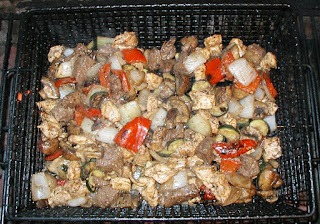
Ready to GoOh, yum, this is ready to go as soon as the chicken is cooked all the way through. The beef, with pieces cut the same size as the chicken, will be medium rare. (If you want them more done cut them smaller.) Be careful when dumping this onto a platter: that basket is hot.
Finished ProductAnd there we have it. Enjoy.